
Remember the late 1990s? The world was practically panicking over the Y2K bug. People were stockpiling canned beans, buying generators, and genuinely expecting airplanes to fall out of the sky the moment the clock struck midnight on January 1, 2000. Of course, nothing happened. The transition was smooth because thousands of programmers worked tirelessly behind the scenes to fix the issue before it could break anything.
Well, I have some news for you. We did it again. Only this time, the deadline isn’t a nice, round year like 2000. It’s a highly specific Tuesday: January 19, 2038, at 03:14:07 GMT.
This is the Year 2038 problem, and while it doesn’t get as much mainstream media attention as Y2K did, it is a very real technical hurdle. If you are using a computer, a smartphone, or relying on any kind of internet service right now, this problem already exists inside your machine. It’s just quietly ticking away in the background.
Table of Contents
How Computers Actually Tell Time
To understand why 2038 is a problem, you first need to understand how computers track time.
Humans look at calendars and clocks. We see dates, months, years, hours, and minutes. But computers don’t understand “Tuesday” or “November.” At their core, computers are just incredibly fast calculators that only understand numbers—specifically, ones and zeros.
So, how do you translate human time into computer math?
Back in the early 1970s, when the Unix operating system was being built, a couple of brilliant engineers decided to keep things incredibly simple. They picked a single, arbitrary starting point and decided that the computer would just count the number of seconds that have passed since that exact moment.
That moment is January 1, 1970, at 00:00:00 UTC. In the tech world, this is known as the Unix Epoch.
Think of it like a stopwatch. If you want to know what time it is right now, the computer doesn’t check a calendar. It simply looks at the stopwatch and says, “It has been 1,719,845,231 seconds since the starting line.” Then, it runs a quick math formula to convert those seconds into a human-readable date on your screen.
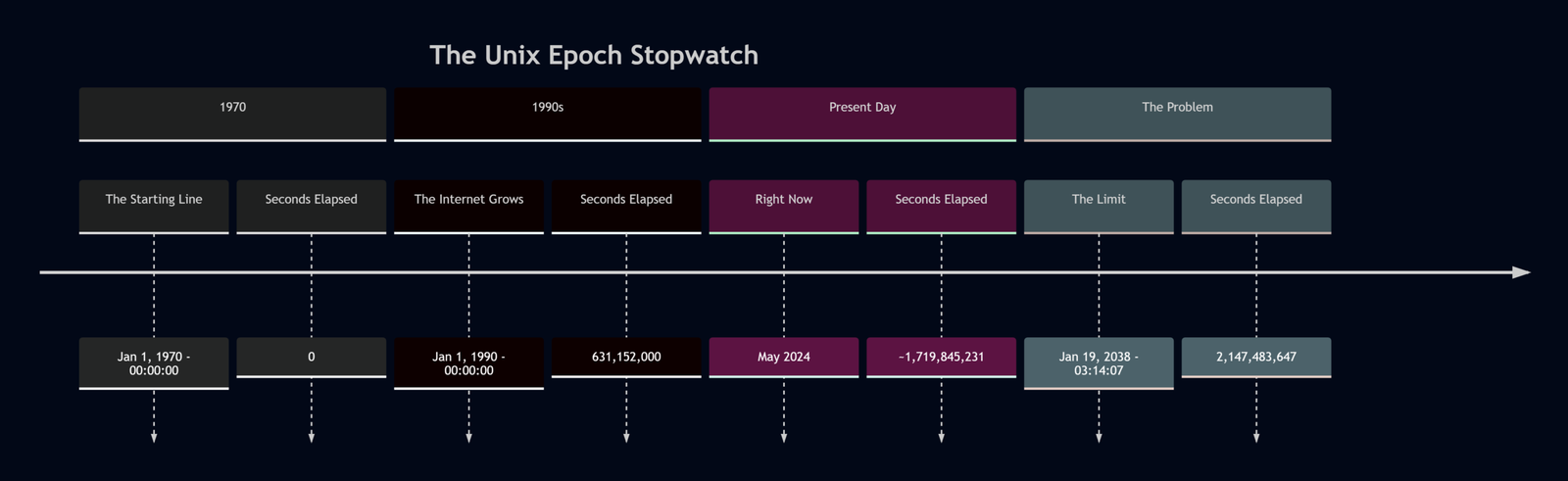
This system is elegant. It completely ignores leap years, time zones, and daylight saving time. The computer just counts raw seconds. When it needs to display the time, the software handles all the complicated calendar stuff.
But there is a catch. That stopwatch has a physical limit.
The “Bucket” Problem: Understanding 32-Bit Systems
When those engineers built Unix in the 70s, computer memory was incredibly expensive. They couldn’t give the stopwatch an infinite amount of space to count. They had to put the number into a specific-sized “bucket” to store it in the computer’s memory.
They chose a 32-bit bucket.
In computing, a “bit” is a single piece of data—a one or a zero. A 32-bit system means the computer uses a sequence of 32 ones and zeros to store a single number.
Because of how binary math works, a 32-bit system can hold a maximum positive number of exactly 2,147,483,647.
Let’s do the math. If we start counting from zero on January 1, 1970, and we count one second at a time, when do we hit the absolute maximum limit of 2,147,483,647 seconds?
You guessed it: January 19, 2038, at 03:14:07 GMT.
Why the Negative Numbers Matter
You might be wondering, “Why not just make all 32 bits positive? Wouldn’t that double the limit?”
They could have, but they needed a way to represent time before 1970. If a computer needs to calculate someone’s age or process a historical document from 1965, the stopwatch needs to go backward. To allow for negative numbers (counting backward from zero), the engineers used a system called Two’s Complement. They sacrificed the highest bit (the leftmost digit) to act as a sign indicator. If it’s a 0, the number is positive. If it’s a 1, the number is negative.
Because of this, the 32-bit bucket is split in half:
- Positive numbers go from
0to2,147,483,647(Dec 13, 1901, to Jan 19, 2038) - Negative numbers go from
-1to-2,147,483,648(Dec 31, 1969, backwards to Dec 13, 1901)
The Big Flip: What Happens at 03:14:08?
So, we are ticking along. It’s January 19, 2038. The clock hits 03:14:07. The computer’s 32-bit bucket is absolutely packed to the brim with ones: 01111111111111111111111111111111.
What happens one second later at 03:14:08?
The computer tries to add one more second to the bucket. But there is no more room. When a computer runs out of space to count up, it suffers an integer overflow. It has nowhere to put the new number, so it does the only thing it can do: it flips the sign bit to a 1 and rolls over to the lowest possible negative number.

In a fraction of a millisecond, the computer’s internal stopwatch jumps from +2,147,483,647 to -2,147,483,648.
When the software asks the operating system, “Hey, what time is it?” the operating system replies, “It is December 13, 1901.”
Why is That So Destructive?
If your laptop suddenly thinks it’s 1901, it’s annoying. Your emails will have the wrong timestamp, and your calendar will be useless. But imagine a computer that relies on time to function properly.
- Banking Systems: Imagine trying to calculate 30 days of credit card interest when the system thinks the current year is 1901. It might try to charge you 120 years of negative interest, crashing the database.
- Airline Booking: You try to book a flight for February 2038. The system looks at the current date (1901), realizes your flight is 137 years in the future, and flags it as an invalid input.
- Backup Software: Many servers are programmed to delete backups that are older than 30 days. If the system flips to 1901, it will look at your backups, calculate that they are from the “future,” and instantly delete all of your company’s critical data to free up space.
- Physical Infrastructure: Power grids, traffic lights, and water treatment plants use scheduled logic. If the timing fails, safety protocols could fail, leading to power outages or mechanical failures.
Who Is Actually at Risk?
Here is the good news: Your brand-new iPhone, your Windows 11 gaming PC, and your modern Mac are completely safe. Most consumer electronics built in the last 10 to 15 years run on 64-bit processors. We will talk about why that fixes the problem in a minute.
The danger lies in legacy systems. A staggering amount of the world’s critical infrastructure still runs on older 32-bit systems.
- Embedded Systems: These are the tiny, dedicated computers hidden inside factory machines, medical equipment, ATMs, and cars. You can’t just “update” an ATM’s software easily. Many of these devices were built 15 years ago, programmed in C or C++, and shoved into a wall. They will still be running in 2038.
- Older Databases: Many large corporations (banks, insurance companies, government agencies) have massive databases running on older architectures. Migrating a bank’s entire financial history to a new system costs millions of dollars and carries its own risks, so they often put it off as long as possible.
- Network Routers and Servers: The backbone of the internet relies on precise timing to route data. While major tech companies have upgraded, smaller ISPs or legacy servers in developing nations might still be running 32-bit Linux kernels.
A Quick Look at the Code (For the Curious)
If you aren’t a programmer, feel free to skip this part. But if you want to see exactly how fragile this is, let’s look at a tiny piece of C code. C is the language that most operating systems are built on.
In C, when you want to work with time, you use a data type called time_t. Historically, time_t was defined as a 32-bit signed integer.
#include <stdio.h>
#include <time.h>

int main() {
    // Set the time to the exact moment of the crash
    time_t t = 2147483647;

    printf("The current time is: %s", ctime(&t));

    // Add exactly ONE second
    t = t + 1;

    printf("After adding 1 second: %s", ctime(&t));

    return 0;
}If you compile and run this code on an old 32-bit system, the output will look like this:
The current time is: Tue Jan 19 03:14:07 2038
After adding 1 second: Fri Dec 13 20:45:52 1901
It is literally that simple. Adding 1 to a full 32-bit bucket destroys the date. This isn’t a virus. It’s not a glitch. It is the computer doing exactly what its engineers told it to do 50 years ago.
Is This Just Y2K All Over Again?
It’s natural to compare the Year 2038 problem to Y2K. They share the same fundamental root cause: programmers saving memory space by cutting corners on how they store dates. But there are some massive differences.
| Feature | Y2K Problem | Year 2038 Problem |
|---|---|---|
| The Core Issue | Using 2 digits for the year (e.g., ’99’ instead of ‘1999’) | Running out of space in a 32-bit mathematical bucket |
| Where it Lives | Mostly in software applications and databases | Deep inside the core operating system (the Kernel) |
| The Fix | Mostly involved finding and expanding date fields in code | Requires recompiling the entire operating system and underlying software |
| Who is Affected | Almost all computers, regardless of hardware | Primarily 32-bit systems (64-bit systems are natively immune) |
| The Warning | Highly publicized, massive panic | Much quieter, mostly known only in IT circles |
Y2K was a data formatting issue. The 2038 problem is a fundamental mathematical limit at the very heart of the operating system. Fixing Y2K was often like doing a “find and replace” in a word document. Fixing 2038 is more like trying to swap out the foundation of a skyscraper while people are still working inside it.
The Ultimate Cure: Moving to 64-Bit
So, how do we fix it? We make the bucket bigger.
The modern standard for computers is the 64-bit architecture. Instead of using 32 ones and zeros to store the time, a 64-bit system uses 64 ones and zeros.
How much time does a 64-bit stopwatch buy us?
Remember, a 32-bit system gave us about 68 years. A 64-bit system doesn’t just double that time. Because of the exponential nature of binary math, it multiplies it billions of times over. The maximum limit for a 64-bit signed integer is 9,223,372,036,854,775,807.
If we start counting from 1970, a 64-bit system will not run out of seconds until the year 292,277,026,596.
To put that into perspective: that is 292 billion years. The universe is only about 13.8 billion years old. The sun will have burned out and died billions of years before the 64-bit stopwatch runs out. We are safe for a while.
| System Type | Total Seconds Capacity | Countdown Starts | Runs Out Of Time |
|---|---|---|---|
| 32-bit signed | 2,147,483,647 | Jan 1, 1970 | Jan 19, 2038 |
| 64-bit signed | 9,223,372,036,854,775,807 | Jan 1, 1970 | Year 292,277,026,596 |
If your computer, phone, or server is running a 64-bit processor and a modern 64-bit operating system, the time_t variable is now 64 bits wide. The Year 2038 problem simply does not exist for you.
If 64-Bit Fixes It, Why Are We Still Talking About It?
You might be thinking, “My laptop is 64-bit, my phone is 64-bit, everything is 64-bit now. Problem solved, right?”
Not exactly. The tech world is like an iceberg. The shiny smartphones and laptops are the tiny part above the water. Below the surface is a massive, hidden infrastructure of legacy systems.
Here is why the 2038 problem is still a headache:
- Deeply Embedded Hardware: As mentioned earlier, the microcontrollers inside factory robots, medical devices, and cars are often 32-bit because they only cost a few cents to manufacture. Upgrading a car’s internal computer isn’t as easy as downloading an iOS update. It requires physical hardware replacement.
- Proprietary Software: Many large corporations run on custom software built in the 1990s or early 2000s. The original programmers have long since retired. The current IT staff is often terrified to touch the code because if they change one line, the whole system might collapse.
- Data Corruption Risks: Even if a company upgrades their server to 64-bit, what happens to the old data? If a 64-bit system tries to read a backup file that was written by a 32-bit system in 2037, it has to know how to interpret those old, maxed-out numbers. If the translation isn’t perfect, the data corrupts.
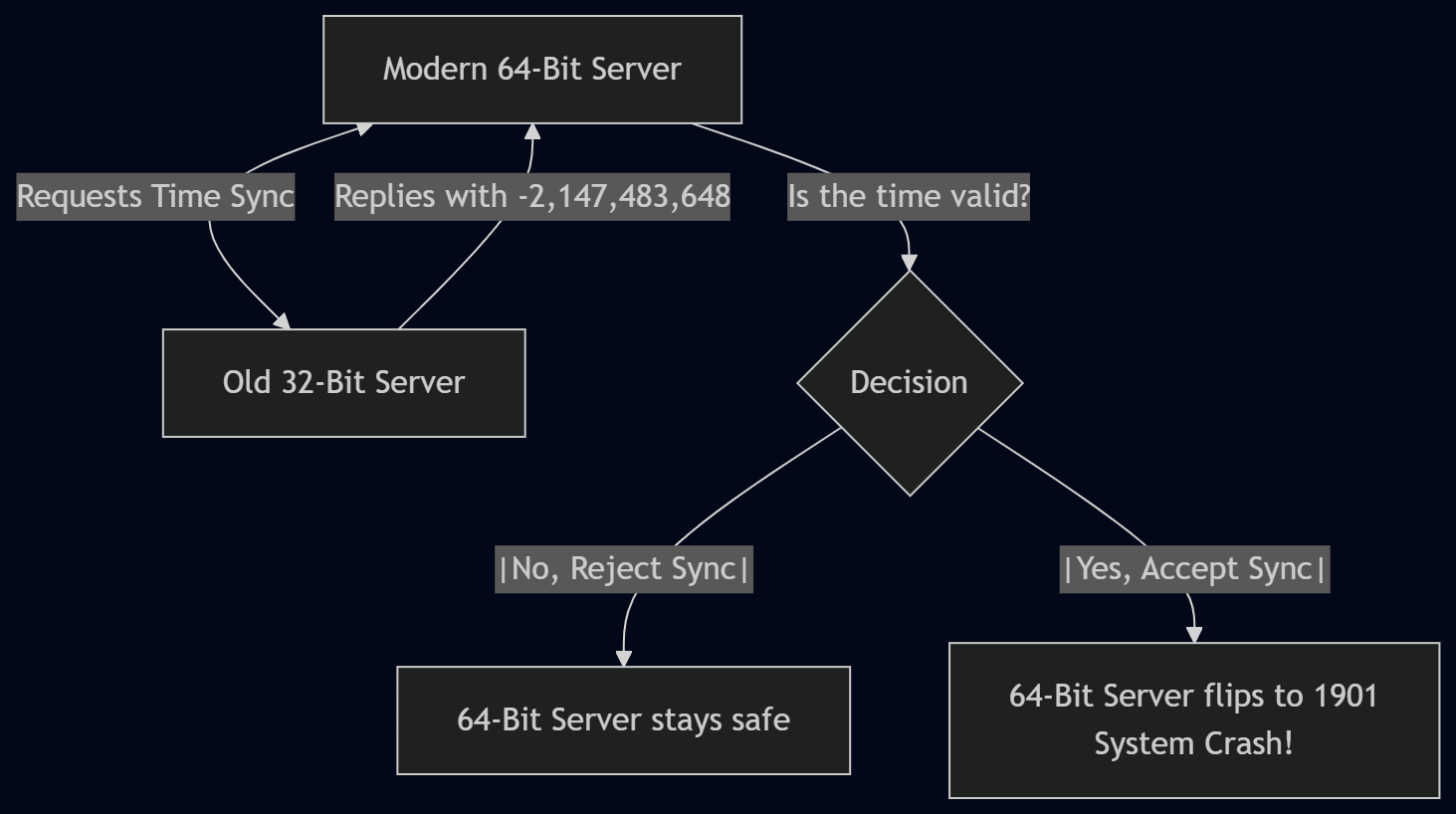
- Network Time Protocol (NTP): Computers don’t just keep their own time; they constantly sync with internet time servers to stay accurate. If a 64-bit server asks a 32-bit server for the time in 2038, the 32-bit server will send back a negative number (1901). The 64-bit server has to be smart enough to reject that garbage data, or it might sync its own clock backward and crash the network.
The Patching Process: How the Industry is Preparing
Unlike Y2K, which was largely ignored until 1998 or 1999, the software industry has been quietly working on the 2038 problem for years.
For example, in the Linux kernel (which runs the vast majority of the internet’s servers), developers have been systematically going through millions of lines of code and changing all time_t variables from 32-bit to 64-bit.
Most modern programming languages (like Python, Java, and modern C++) have already updated their internal time libraries to be 64-bit safe, regardless of whether they are running on a 32-bit or 64-bit machine. They use clever workarounds to simulate a 64-bit bucket even on older hardware.
However, the real challenge isn’t writing the patch. The challenge is testing.
When a bank patches its system to handle 64-bit time, they can’t just flip a switch. They have to simulate the year 2038 in a secure, offline environment. They have to run millions of fake transactions through the system to see if the new code breaks any of their other, older software. This testing process takes years and costs a fortune.
Should You Panic?
Absolutely not.
For the average person, the Year 2038 problem will be a complete non-event. By the time 2038 rolls around, the smartphone in your pocket will likely be a holographic AI assistant running on a 128-bit processor. Your home Wi-Fi, your smart TV, and your gaming console will be perfectly fine.
The people who are working hard to fix this are the unsung heroes of the tech world: backend engineers, database administrators, and cybersecurity experts. They are the ones painstakingly updating old code, running simulations, and ensuring that the invisible backbone of our civilization doesn’t snap.
The Year 2038 problem is a fascinating reminder of a simple truth: every shortcut we take in technology eventually comes due. The engineers of the 1970s made a brilliant, necessary decision to use a 32-bit stopwatch. They saved billions of dollars in computing costs, which arguably allowed the internet to grow as fast as it did.
They just didn’t expect their creation to survive for 70 years. But it did. And now, it’s our turn to maintain it.
WrapUP
The Year 2038 problem is a fascinating piece of computer history that is still actively unfolding. It teaches us how computers fundamentally view the world—not as a flowing river of time, but as a rigid stack of numbers waiting to overflow. While the tech world has a clear path forward by adopting 64-bit architectures, the sheer volume of legacy systems means the transition will require meticulous effort, rigorous testing, and significant investment over the next decade and a half. We don’t need to panic, but we definitely need to pay attention to the people doing the work behind the scenes.
References:
- The GNU C Library (glibc) 2038 readiness documentation
- Linux Kernel documentation regarding 64-bit time_t transitions
FAQs
What exactly is the Year 2038 problem?
Think of it like a car’s odometer rolling over from 99,999 miles back to zero, but for computer time. Older computers track time by counting the seconds since January 1, 1970. They gave this digital stopwatch a limited amount of space to hold numbers. On January 19, 2038, that space fills up completely, and the counter resets. When it does, the computer gets confused and thinks the date is suddenly back in 1901.
Will my phone or personal computer crash when 2038 happens?
No, you are completely safe. Almost all smartphones, Macs, and Windows PCs built in the last ten to fifteen years use modern “64-bit” brains. This just means they have a massively bigger space to hold the time counter—so big that it won’t fill up for another 292 billion years. Your personal devices won’t even notice the date change.
Why did programmers make this mistake in the first place?
It wasn’t really a mistake; it was a necessary trade-off. Back in the 1970s, computer memory was ridiculously expensive and incredibly tiny. Using a smaller space to store the time saved a lot of money and allowed the systems to run faster. They figured the technology would be replaced long before the year 2038, but those old systems were so well-built that they ended up forming the hidden foundation of the modern internet.
How is this different from the Y2K bug from the year 2000?
Y2K was mostly a formatting issue where programmers used two digits for the year (like “99” for 1999) to save space, so computers thought 2000 was 1900. The 2038 problem is a hard mathematical limit buried deep inside the core operating system. Fixing Y2K was often like doing a find-and-replace in a document, whereas fixing 2038 requires rebuilding the underlying engine of the software.
What actually happens to a computer when the time runs out?
When the digital counter hits its maximum limit and tries to add one more second, it suffers something called an “overflow.” It flips a switch that turns the number negative. So, instead of reading January 19, 2038, the computer suddenly reads December 13, 1901. Anything that relies on the correct date—like calculating bank interest, scheduling flights, or running automated backups—will completely fail, delete data, or act very strangely.